Dmaathen (1976)
(ENGLISH VERSION BELLOW)
5 min de lectura.
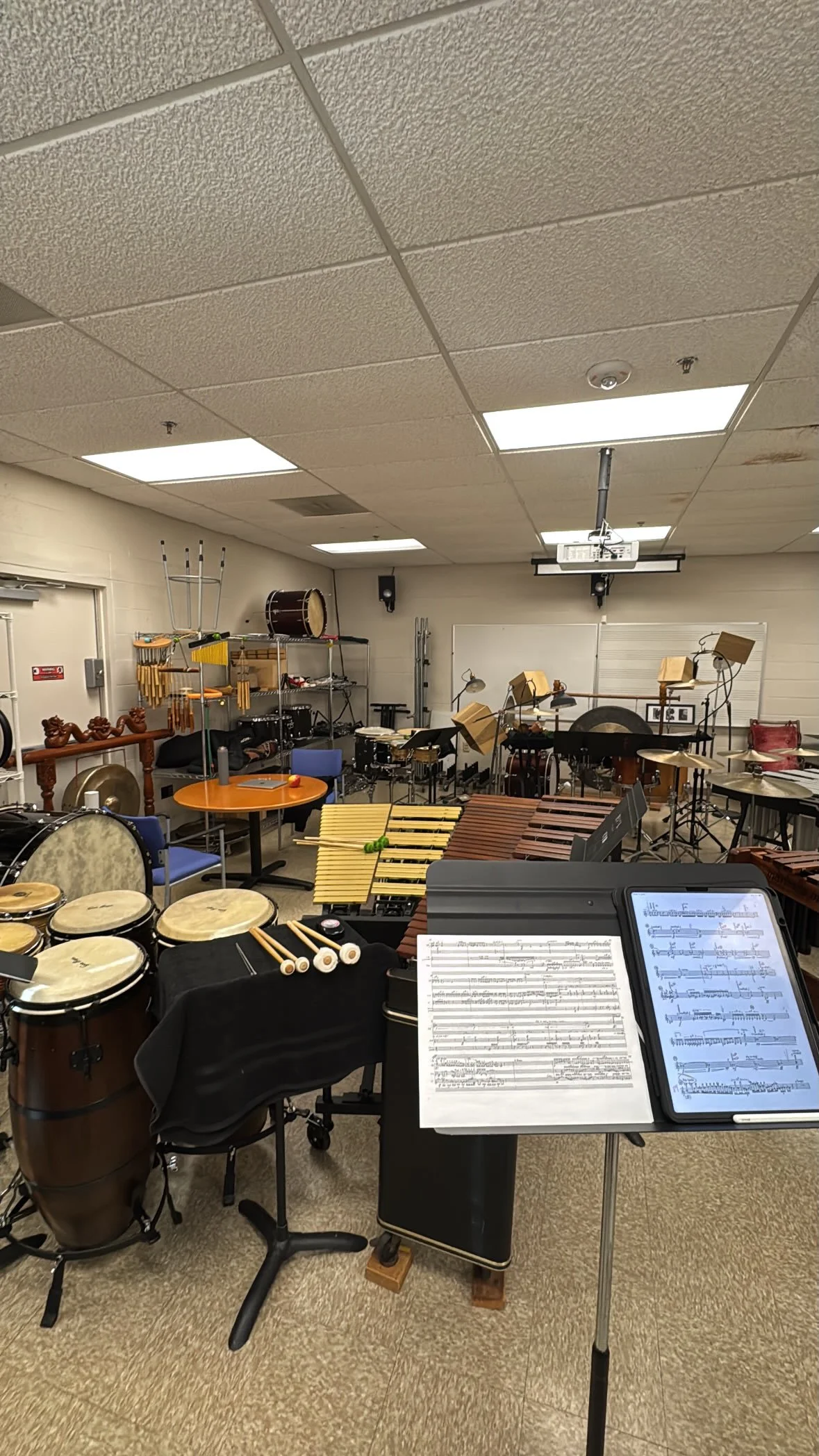
Si me remonto al génesis de esta aventura, tengo que ir muy atrás en el tiempo, a uno de esos conciertos a los que mi padre me llevaba a UCSD cuando era morro. Ahí, probablemente escuché por primera vez a Steven Schick y a Xenakis. Nunca hubiera esperado que, muchos años después, estaría en ese mismo edificio, el Warren Lecture Hall, ensayando con Steve una obra de Xenakis.
Al terminar mis estudios de la universidad, apliqué para UCSD. No me aceptaron y, además de no tener dinero para pagar la escuela (aún no lo tengo, gracias becas), ese cierre de puerta curiosamente abrió la ventana que me dio la oportunidad de vivir la aventura de estudiar en Ámsterdam. Mirando atrás, creo que fue lo mejor: en lugar de profundizar en una sola tradición pedagógica, esa decisión del destino expandió mis fuentes de aprendizaje y mi visión musical de una manera que nunca hubiera planeado.
Esta experiencia reafirma una convicción muy personal: si vas a tocar un instrumento del canon occidental (es decir, instrumentos europeos), un entrenamiento clásico y tradicional, aunque muchos lo vean como algo viejo, es fundamental. Incluso yo mismo pienso que las orquestas a veces son museos (y toco en uno de ellos), pero ese estudio te da las herramientas y te abre las puertas para hacer música nueva, música experimental, y sobre todo, para poder tocar notas con significado.
Si tu meta es quedarte en el mundo de la "música antigua" y no hablo del fascinante mundo de los instrumentos de época, que ya es de por sí una aventura experimental, sino de tocar a Bach, Mozart o Mahler con instrumentos modernos, está perfecto. Lo necesitamos. Pero con esa base técnica y de lenguaje, desarrollas también las herramientas para aventurarte en lo experimental. Esta es una opinión muy personal, y te invito a que estés en total desacuerdo. Me da igual.
En resumen, creo que irme a Ámsterdam a tocar Mozart es la única razón por la que hoy puedo enfrentarme a Xenakis. No se trata solo de tocar notas, sino de saber qué significado tienen.
Dmaathen es el nombre de la obra. Fue escrita para oboe y percusiones, y al parecer "Dmaathen" es una palabra inventada por el mismo Xenakis. Como leí en un post de una gran oboista y Steve lo confirmó, probablemente alude a domar, domesticar, amansar. Para mí, esto le queda perfecto al oboe. Siempre estamos intentando domesticar el instrumento, cuando en realidad no nos hemos dado cuenta de que él nos domesticó a nosotros hace muchos años.
Tenemos que trabajar el doble que otros músicos para que funcione, pero al mismo tiempo no podemos trabajar tanto porque físicamente es imposible. Tenemos que hacer nuestras propias cañas, algo en lo que yo he fracasado épicamente durante los últimos años. Y justo cuando logras "domesticar" el oboe y haces cañas casi perfectas (spoiler alert: no existen), llegan las grietas en el instrumento, la humedad, la altura... y llega Xenakis. Con sus saltos de dos octavas a velocidad luz. Con ese whistle note imposible de lograr de manera tradicional. Con su exhaustivo uso de multifónicos que terminan destrozando tu embocadura.
Xenakis llega con una obra que nos regresa a tiempos primitivos, donde creo que el oboe representa a la naturaleza y las percusiones al ser humano, pues mientras el oboe puede tener líneas largas de multifónicos sin ningún ritmo obvio o lógico, las percusiones se muestran más con esas métricas artificiales que no encuentras en la naturaleza, sino en la mente del hombre. Dmaathen es una cápsula de la historia de la música: hay momentos que suenan como si estuviéramos en las cavernas tallando lanzas; otros con gestos casi barrocos; y otros que suenan tan experimentales, como si los estuviéramos descubriendo ahora, pero que fueron escritos hace 50 años. Hay sonidos artificiales, puramente sónicos, y momentos donde el oboe es solo aire atravesando campos inmensos de pasto.
Dmaathen me está enseñando que incluso Steve, que la aprendió hace décadas, nos presta aún un espacio para aprender, para hacer música de cámara de verdad: dialogar, crear, reinventar. Para despertar emociones. Y al final, ¿qué es el arte sino un medio para despertar sentimientos?
Es una obra que se programa muy poco. Si algún día soy profesor en un conservatorio o universidad, será parte del repertorio obligado. Creo que no se toca porque los músicos a veces no nos animamos a exponernos a tales dificultades.
Y aquí estoy, escribiendo esto, cuando debería estar preparando mis ensayos para la candidatura al doctorado. En fin, la hipotenusa.
ENGLISH
Dmaathen (1976)
If I go back to the genesis of this adventure, I have to go way back in time, to one of those concerts my father took me to at UCSD when I was a kid. That's probably where I first heard Steven Schick and Xenakis. I never would have expected that, many years later, I would be in that same building, Warren Lecture Hall, rehearsing a Xenakis piece with Steve.
After finishing my university studies, I applied to UCSD. They didn't accept me, and besides not having the money to pay for the school (I still don't, thank you scholarships), that closed door curiously opened a window, giving me the opportunity to experience the adventure of studying in Amsterdam. Looking back, I think it was for the best: instead of delving into a single pedagogical tradition, that twist of fate expanded my sources of learning and my musical vision in a way I never could have planned.
This experience reaffirms a very personal conviction: if you're going to play an instrument from the Western canon (that is, European instruments), a classical, traditional training, although many see it as something old-fashioned, is fundamental. I myself think orchestras are sometimes museums (and I play in one of them), but that type of musical training gives you the tools and opens doors for you to make new music, experimental music, and above all, to be able to play notes with meaning.
If your goal is to stay in the world of "old music", and I'm not talking about the fascinating world of period instruments, which is an experimental adventure in itself, but about playing Bach, Mozart, or Mahler on modern instruments, that's perfect. We need that too. But with that technical and linguistic foundation, you also develop the tools to venture into the experimental. This is a very personal opinion, and I invite you to totally disagree. I don't mind.
In short, I believe that going to Amsterdam to play Mozart is the only reason I can now face Xenakis. It's not just about playing notes, but about knowing what meaning they have.
Dmaathen is the name of the piece. It was written for oboe and percussion, and apparently "Dmaathen" is a word invented by Xenakis himself. As I read in a post by a great oboist and Steve confirmed, it likely alludes to taming, domesticating, subduing. For me, this fits the oboe perfectly. We are always trying to tame the instrument, when in reality we haven't realized that it tamed us many years ago.
We have to work twice as hard as other musicians to make it work, but at the same time we can't work that much because it's physically impossible. We have to make our own reeds, something I have failed at epically in recent years. And just when you manage to "tame" the oboe and make almost perfect reeds (spoiler alert: they don't exist), cracks appear in the instrument, humidity sets in, altitude changes... and Xenakis arrives. With his more than two-octave intervals at light speed. With that impossible-to-achieve whistle note in a traditional way. With his exhaustive use of multiphonics that end up destroying your embouchure.
Xenakis arrives with a piece that takes us back to primitive times, where I believe the oboe represents nature and the percussion represents humanity, since while the oboe can have long lines of multiphonics without any obvious or logical rhythm, the percussion manifests itself more with those artificial metrics you don't find in nature, but in the mind of man. Dmaathen is a capsule of music history: there are moments that sound as if we were in caves carving spears; others with almost baroque gestures; and others that sound so experimental, as if we were discovering them now, but which were written 50 years ago. There are artificial, purely sonic sounds, and moments where the oboe is just air crossing immense fields of grass.
Dmaathen is teaching me that even Steve, who learned it decades ago, still lends us a space to learn, to truly make chamber music: to dialogue, create, reinvent. To awaken emotions. And in the end, what is art if not a means to awaken feelings?
It's a piece that is rarely programmed. If I ever become a professor at a conservatory or university, it will be part of the required repertoire. I think it's not played because we musicians sometimes don't dare to expose ourselves to such difficulties.
And here I am, writing this, when I should be preparing my essays for my doctorate qualifications. In the end, the hypotenuse. (That last bit works in Spanish, not sure if it does in English).